In the name of God, the Most Gracious, the Most Merciful. Praise be to God, Lord of the Worlds, and peace and blessings be upon our Prophet Muhammad and upon his family and companions.
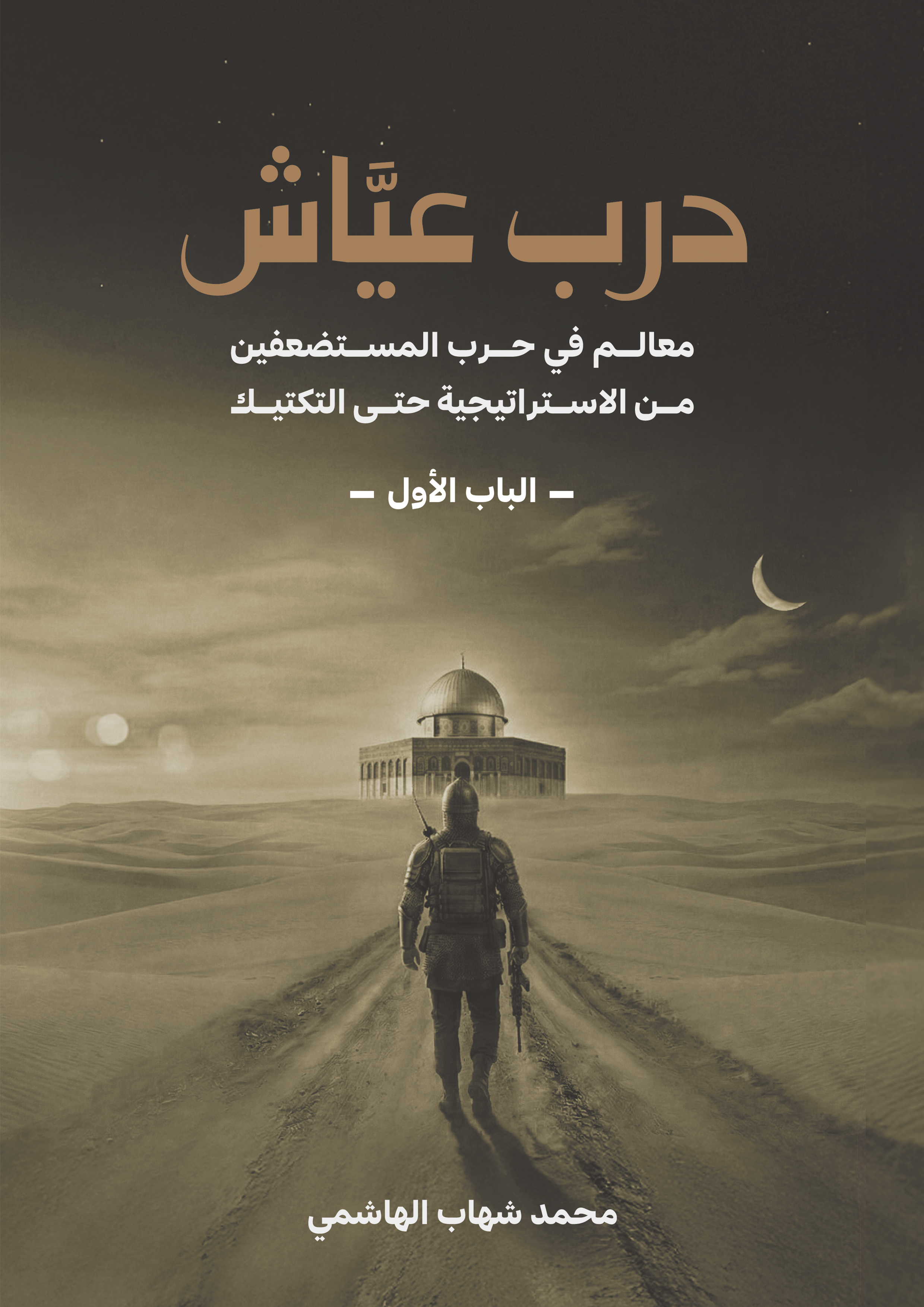
Darb Ayash is not just a war book containing valuable information for a rebel or fighter... but a bold attempt by the author to grasp the essence of war in its entirety, Establishing its principles, clarifying its stages, and delving into its details—and here we do not mean by this only the first published chapter, but also the rest of the parts, Which will be released soon, And this—to the best of my limited knowledge is something that no other Arabic or translated book has done, except for Clausewitz's "On War," but The blood of the latter - approximately 200 years - and its synchronization with an international reality that differs radically fromOur situationSimilarly, his use of battles far removed from our reality makes it difficult to benefit from them inBuilding this perceptionIt is extremely difficult, unlike our published book, and God Almighty is the Most High and the Most Wise.
Once the reader has this general understanding of the war situation, he will find it easy to apply it to any other war context, and even a strategic one..
The book consists of four chapters, which will be published in four parts, God willing. What is published now is its first part, which includes the first chapter, and it is divided into four sections:
As for his first chapterHe simplified and explained the concept of strategy comprehensively, explaining it as a working logic and a mechanism of thinking, and clearly distinguishing it from strategic planning, while clarifying the problem between taking it from the administrative approach and the military approach... all of this with examples.
Then the chapter distinguished between the levels of conflict, starting from the highest level, i.e., the civilizational conflict, down to the lowest level, i.e., the tactical level. This is a distinction that is rarely found in Arabic sources, and if you do find it, you find it as titles without sufficient explanation. In our case, however, the distinction between them was made in detail, with historical and contemporary examples given to illustrate the differences between them. And, thanks to God, the most beautiful thing is to clarify the overlaps and the effects of each of them on the other.
The chapter also clearly and remarkably clarified the author’s viewpoint on the concept of military doctrine and the discussions surrounding it. He favored the use of the term “military doctrine” instead of “doctrine,” and explained the differences between them, along with an explanation of the branches of the doctrine that are fully consistent with the previous levels of conflict. This connection and distinction was also not found in any other Arabic source.
The chapter concluded with practical rules for the daily practice of leaders and even ordinary individuals, introducing the logic of strategy and strategic thinking into daily life...
As for his second chapter It is a practical guide, a "catalogue," for overthrowing tyrannical regimes. It is not a philosophical theorizing of the concept of guerrilla warfare, as Robert Taber did creatively in his distinguished book "The War of the Oppressed" - from which we derived the title of our book - but he established that theorizing and then laid the foundations for it according to practical steps that begin from scratch, from the days of peaceful resistance, which we did not elaborate on, and then starting with the first few rebels taking up their rifles to confront the hordes of tyranny.
The chapter included details of this war, extending from its first phase, "the war of attrition," to the second, "strategic balance," concluding with the third, "military resolution," expanding on the first because it was the most complex and important, and then becoming more and more concise in the second and third.
Then the chapter contained an important and distinguished discussion, thanks be to God, on the subject of hybrid warfare, which had a wide resonance in the past during the days of the Syrian revolution, especially after 2020. We adopted a slightly different approach from the prevailing one, as we adopted the principle of "No hybrid war!" but rather a hybrid enemy.
In his third chapter, he dealt with the principles of war, which are the core of military doctrine, beginning with establishing the concept of the military principle itself and how it is applied.
Then he recites those principles to us, establishing them one by one, explaining and clarifying them with examples, and even explaining the mechanism of adhering to the principle throughout the stages of the revolutionary war itself, and from them you can measure against the traditional ones.
As for the fourth chapter, the writer takes us from theorizing to practicality, and from thought to the field, starting with the revolutionaries in their first moments following their decision to resort to the military option in the face of the brutal tyrant, up to the end of every military action.
This journey begins with a geo-military survey, followed by the organization of a target bank that establishes a balanced and flexible methodology in dealing with the reality of the armed revolution in its early stages. Then it moves on to collecting information about the enemy, detailing it on the Sun Tzu table, that is, morale, order, leader, land, and sky, expanding on each of them not only so that the seeker understands the nature of these frameworks about his enemy, but also about himself and his group, for Sun Tzu said: He who knows his enemy but does not know himself, every victory he achieves will be followed by a defeat that will overwhelm him!
The axis of the leader in particular carried a detailed description of his qualities, in a pleasant and distinctive manner, based in all of that on what the first and greatest leader was, our master Muhammad, the Messenger of God, may God’s prayers and peace be upon him.
Then he moves on to the development of the war plan, where it begins, what governs it, who discusses it, and how it is proven.
Then he moves on to practicing the plan, expanding on the concept of training itself and its importance in the overall context of war.
Then he moves on to the controls for implementing the previous plan, the importance of the leader's role in that, and what he is responsible for.
Then it moves to the last stage, which is exiting that military operation. We are not talking about a mere withdrawal of forces on the ground, but rather how to make political use of an operation that may cost lives and significant time in the course of the overall war.
This is the overall context of the first part, and it is an indispensable source of knowledge for any intellectual concerned with his nation and religion, whether from this book or others. The author established the importance of this idea in the reality of our nation in the introduction to the book after explaining the journey of writing the book itself, clarifying the roots of the state of weakness in which his nation lives and the main reason for the humiliation that we have been afflicted with...
We ask God to make it beneficial, to make it a proof for us and not against us, to guide us to the paths of righteousness, and to show us the glory and elevation of this nation after a long period of slumber and dormancy.
May God bless our Prophet Muhammad, his family and companions, and grant them peace.









Rating and Comments
There is no comments ...